The rise of generative search experiences like ChatGPT and Google’s AI summaries has changed buyer behavior.
People don’t open ten tabs anymore. They ask generative search to summarize, compare, and narrow options for them.
“What’s the best software for X?”
“How do these tools actually differ?”
“Which one fits my situation?”
Research backs this up. Nearly 9 in 10 buyers now use generative search alongside Google at some point in their research.
AI has become the fast lane. A way to sense-check options, pressure-test vendors, and decide who even deserves deeper consideration.
This changes the stakes for brands.
Ranking well in traditional search no longer guarantees influence. If your brand doesn’t show up in AI-generated answers during ‘product evaluation’ stage searches, you’re likely to be left out of the consideration set.
This means AI SEO is no longer just another visibility channel.
It’s how brands avoid disappearing during the moments that shape shortlists and decisions.
So if you’re trying to stay competitive as search behavior evolves and want to make sure your brand still shows up during high-intent moments, this guide is for you.
We’ve rounded up AI SEO agencies that understand this shift and how to build AI SEO strategies that get companies recommended consistently.
What Does an AI SEO Agency Actually Do?
AI SEO marketing is about making sure your brand shows up accurately and consistently inside AI-generated answers across tools like ChatGPT, Claude, and Google’s AI summaries, where buyers now compare options and decide who makes the shortlist.
AI SEO agencies help shape whether your brand is included, how it’s described, and when it’s recommended in those answers.
Because generative search systems want to sound correct and trustworthy, they pull signals from many places at once, your website, comparison content, review sites, Reddit threads, and other authoritative sources.
AI SEO works by making those signals clear, consistent, and easy to interpret, and AI SEO agencies support this by offering services that typically include:
- Audit where you already appear (or don’t) in AI-generated answers and overviews
- Identify the questions and comparisons buyers ask, especially around evaluation and shortlisting
- Optimize existing content so it can be accurately summarized and reused in answers
- Create or refine comparison, FAQ, and explainer content that’s more likely to be cited
- Strengthen entity and brand signals across your site and trusted third-party sources (including Reddit, Quora, and authoritative review content)
- Improve technical clarity (structure, schema, internal linking) so content can be retrieved confidently
- Track AI visibility over time and iterate based on what actually surfaces
The best AI SEO agencies don’t replace SEO or chase hacks. They extend strong SEO into generative search, making sure the authority you’ve built continues to influence decisions before a click ever happens.
8 Best AI SEO Agencies to Consider
The AI SEO agencies below are some of the strongest options today, depending on your goals, team structure, and growth stage.
1. Spicy Margarita - Best Generative Engine Optimization Agency for B2B

Spicy Margarita is a boutique B2B SEO and AEO agency with one guiding rule: their work creates revenue, not just traffic or "visibility".
A lot of agencies will show you an impressions graph and call it a win. Spicy Margarita genuinely gets that traffic quality matters. They trace the line all the way to closed-won, building strategies around the question of what moves a buyer from "never heard of you" to "booked a call."
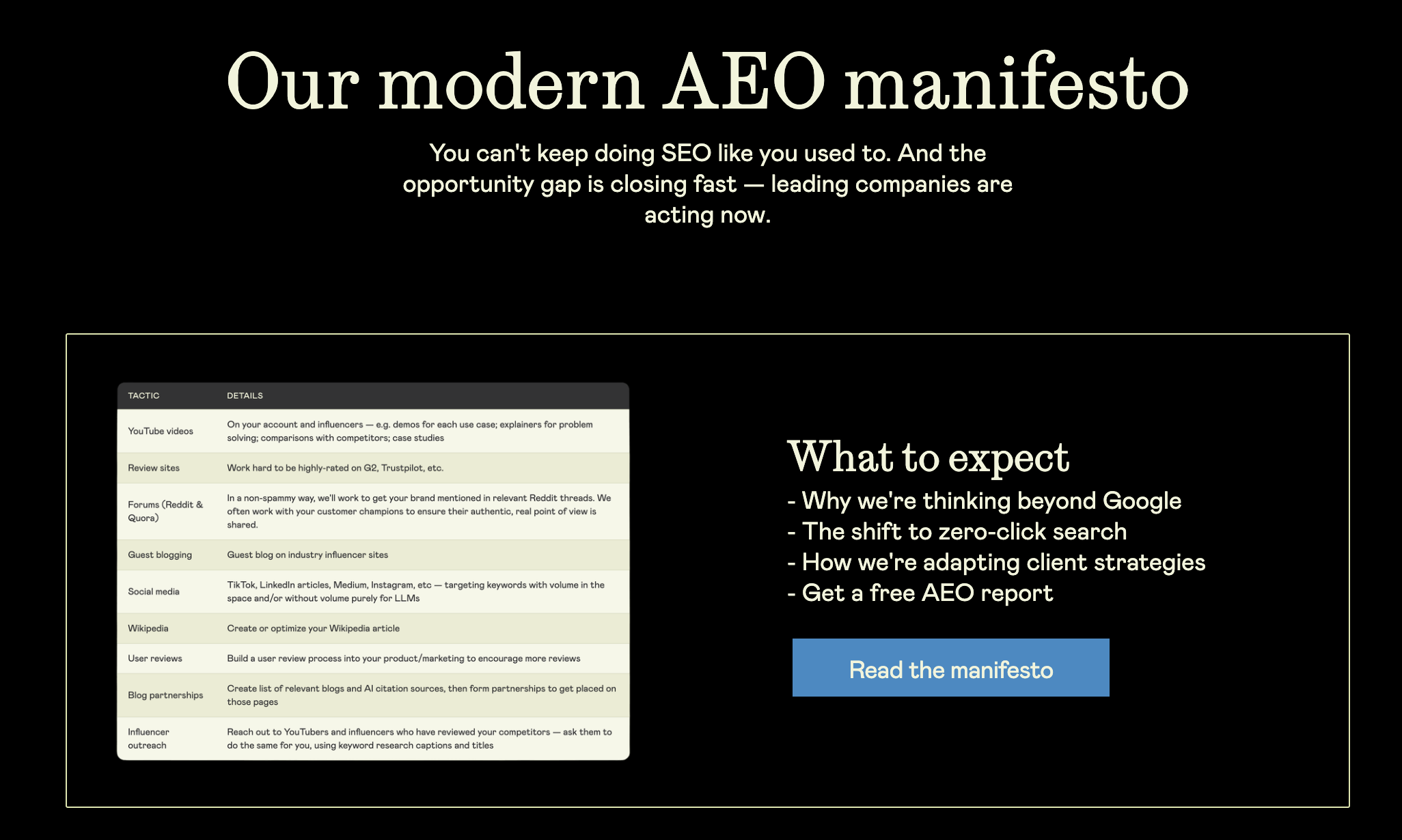
As search fragments across Google, ChatGPT, Reddit, and YouTube, they've built a full answer engine optimization practice around the new SEO. They help brands own a problem space and become the default choice, wherever your prospects are looking.
Services span the whole stack:
- SEO strategy
- AI SEO
- Content production
- Link building
- AI citation outreach
- Reddit and social search.
As a boutique agency, Spicy Margarita nevers works with more than 10 clients at once. They state that this allows them to give whiteglove service to every single client.
Case studies:
- One client added 90 top-3 keyword rankings and 40% AI search visibility in three months.
- Another attributed $2M in closed business and 81 monthly sales calls to the engagement.
- A third hit $1M in new ARR.
Chris Walton, a founder of a B2B services firm called Eton Venture Services, called the decision to hire them one of his top three ever in 16 years of doing business.
Best for:
B2B companies that are tired of SEO that looks good in a report but doesn't show up in pipeline. Specialty: Helping brands with new fundraising scale up.
Read their modern SEO manifesto here:
2. Notebook
Notebook is an SEO and generative search consultancy that’s carved out a clear niche helping established B2B SaaS and enterprise brands improve how they show up inside AI-generated answers.
What sets the agency apart is their Trust Alignment Framework™, a methodology built to move brands from being passive mentions in AI outputs to becoming regular recommendations in high-intent queries.
Instead of chasing generic visibility, this framework prioritizes factual alignment, making sure AI systems describe a product with decision-critical details like pricing clarity, integration support, compliance positioning, and ideal customer fit.
This is why their work revolves around:
- aligning how AI tools describe products with buyer expectations
- structuring comparison and alternatives content so it gets sourced confidently
- building entity clarity and schema that support accurate retrieval
- ongoing monitoring of AI outputs to catch drift or misinterpretation
Because, like Spicy Margarita, Notebook prioritizes AI visibility at the evaluation stage by shaping how products appear in comparison and recommendation prompts, we recommend it for brands aiming to influence buyer shortlists rather than pure early-stage discovery.
3. Mike Khorev
Mike Khorev is a seasoned AI SEO consultant who has spent over a decade helping B2B, SaaS, software, and technology companies build organic visibility that converts. Where most options on this list are agencies with account managers and layered teams, Mike operates differently: clients work directly with him from AI visibility strategy through execution.
That distinction matters as AI search evolves. Generative tools don't just surface information, they interpret how clearly a brand is positioned, how consistently it appears across trusted sources, and whether its content directly answers the questions buyers are actually asking. Mike's approach is designed around exactly those signals.
His AI SEO consulting work includes:
- AI visibility audits across ChatGPT, Perplexity, Google AI Overviews, AI Mode, and Gemini to identify where your brand appears, how it's described, and where it's missing
- Content strategy and optimization built around evaluation-stage queries, comparisons, and decision-driven prompts where AI tools shape buyer shortlists
- Technical SEO execution, including site architecture, schema markup, and crawlability improvements that support confident AI retrieval
- Link building and citation outreach on high-authority, niche-relevant sites to strengthen off-site trust signals that generative systems draw from
- Entity and brand signal alignment to ensure AI tools describe your product accurately and consistently across owned and earned content
- Ongoing AI visibility tracking tied to ranking movement, traffic growth, and lead generation
Mike concentrates AI SEO work on the moments that most directly influence decisions: comparison queries, "best for X" prompts, and alternatives searches where buyers are actively narrowing options.
Because those are the queries where AI tools play the most direct role in shaping shortlists, optimizing for them requires a different approach than broad-awareness visibility. His work prioritizes content and signals that show up during those high-intent moments, not just general brand mentions.
Mike Khorev is a strong choice for B2B, SaaS, and tech companies that want hands-on AI SEO expertise without agency overhead, and need someone who can connect technical execution, content strategy, and AI visibility into a single coherent program.
4. Go Fish Digital
Go Fish Digital is a full-service digital marketing agency that has integrated AI SEO into a broader stack of SEO, digital PR, paid media, and content services.
Their AI SEO services are supported by a proprietary toolset, Barracuda, which pinpoints gaps in AI visibility and helps prioritize changes that improve inclusion in AI summaries and overviews.
This keeps their generative search work tightly tied to measurable performance, not just presence, and gives them an analytical edge when optimizing at scale.
Their GEO execution typically includes:
- audits and semantic analysis that map content to how AI systems interpret topical authority
- technical SEO and architecture optimization to ensure reliable retrievability
- digital PR and citation building to reinforce off-site trust signals
- integrated performance reporting that connects AI visibility with broader search and marketing outcomes
Go Fish Digital works with a mix of ambitious mid-market and enterprise brands across industries, including names like Wayfair, City Mattress, Adobe, Joybird, Chicco, and SimpleTexting.
5. 42DM
42DM is a B2B marketing agency that approaches AI visibility through SAIO (Search Artificial Intelligence Optimization), their framework for adapting SEO to how AI systems surface and compare vendors inside tools like Google AI Overviews, ChatGPT, Gemini, and Perplexity.
Rather than running AI SEO as a parallel channel, SAIO is embedded into core SEO execution, spanning technical foundations, content structure, and authority signals, so AI visibility builds on the same systems that support search performance more broadly.
Like several of the other agencies on this list, 42DM concentrates much of its AI-focused work around evaluation-stage queries, where AI tools play a more direct role in influencing which brands buyers seriously consider.
Their SAIO approach shows up through:
- audits and strategy tied to AI-driven evaluation queries
- technical SEO and schema designed for AI retrieval
- comparison and evaluation content optimized for AI sourcing
- third-party citations and trust signals
- ongoing tracking of AI visibility shifts
42DM works almost exclusively with B2B tech companies, including SaaS, fintech, AdTech, MarTech, and cybersecurity brands.
Clients such as Payoneer, CloudCall, Zeeto, and Lumin reflect their focus on competitive B2B categories where AI-driven comparison increasingly shapes buying decisions.
6. Animalz
Animalz is a content-first agency that has extended into AEO by applying their editorial and strategic content expertise to AI visibility.
This AEO focus means making sure existing and new assets are strong sources for generative search answers to read, summarize, and cite accurately.
Their AEO services cover:
- AI visibility audits across tools like ChatGPT, Perplexity, and Google’s AI experiences
- content refreshes aligned with how answer engines summarize information
- new content creation around high-value prompts and questions
- citation outreach across sources AI systems frequently reference
- selective Reddit engagement in threads AI tools surface
- measurement and reporting around AI mentions and downstream impact
While Animalz understands and audits technical requirements such as site structure and crawlability, and implements content-layer optimizations like schema markup, their core strength is content strategy, thought leadership, and editorial production.
For more complex technical work, they flag what’s needed and recommend clients handle implementation with their own development teams.
This makes them a strong fit for companies with solid SEO foundations and established content programs that want to extend authority into AI answers without overhauling their technical stack.
Teams looking for a more end-to-end AI SEO approach, including deeper technical execution, tighter control over evaluation-stage prompts, and faster iteration across structure and entities, may instead consider an AI SEO agency like Spicy Margarita.
7. iPullRank
iPullRank describes its approach to AI search as “Relevance Engineering”, a way of designing SEO and AI visibility around how generative systems determine what information is relevant enough to retrieve and assemble into answers.
Many AI SEO agencies address these mechanics as part of broader execution. iPullRank makes them the primary starting point.
Their work places heavier emphasis on how questions expand, which specific sections of content get pulled, and how brands are understood and compared inside AI-generated answers.
Content strategy and optimization then follow from those relevance signals, rather than leading the process.
Their Relevance Engineering approach translates into:
- planning coverage around how AI expands and connects related questions
- structuring content so individual sections are extractable and reusable in AI answers
- strengthening how brands and topics are connected across owned and earned media
- coordinating technical SEO, content strategy, digital PR, and UX under a single relevance model
- evaluating AI visibility in terms of demand and revenue influence, not just citations
Because of this relevance-first orientation, iPullRank is particularly well suited to enterprise organizations with large, complex content ecosystems, where AI visibility depends on consistency and structure across many surfaces.
8. Graphite
Graphite is an AI-powered SEO and AEO agency built around one core idea: most growth comes from a small number of high-impact topics and page systems, not from dozens of incremental optimizations.
Instead of optimizing pages one by one, Graphite identifies which topics, user journeys, and page types statistically drive visibility and demand, then scales those patterns across large sections of a site.
Their work includes:
- topic and persona mapping instead of keyword-level targeting
- scalable page templates for comparisons, questions, and evaluation journeys
- high-volume content generation aligned to proven topic patterns
- AEO and citation optimization baked into content systems
- technical foundations (architecture, crawlability, internal linking) designed for scale
- custom dashboards and forecasting to track velocity and ROI
Graphite is a great fit when the goal is to move fast and expand topical footprint, focusing on system-level improvements rather than frequent changes to individual AI answers.
However, teams that also need close, hands-on tuning of how their brand appears inside specific AI-generated answers or evaluation prompts may prefer a partner like Spicy Margarita whose workflow stays close to live generative results.
6 Common Mistakes When Hiring an AI SEO Agency
Because AI SEO is evolving so fast, it’s easy to hire the wrong kind of help. Before you choose an agency, watch out for these common mistakes that can waste your resources without improving real visibility:
1. Treating AI SEO like PR or “brand mentions”
Some agencies sell AI SEO as getting your name dropped in as many places as possible. That misses the point.
AI tools care about clarity, accuracy, and usefulness, not buzz. Random mentions won’t help if your content doesn’t actually answer the questions buyers are asking.
2. Thinking more content equals more AI visibility
Publishing at scale without structure usually backfires, and AI systems don’t reward volume. They surface content that’s easy to interpret, factually consistent, and clearly positioned.
Ten messy blog posts won’t beat one well-structured asset, think a clear product comparison, a focused “best for X” page, or a concise explainer that directly answers a common buyer question.
3. Treating AI SEO as a shortcut
A common mistake is thinking you can “add AI SEO” without fixing or strengthening your SEO foundation. In practice, that almost never works.
Generative tools still pull from the same signals SEO has always relied on: crawlable sites, clear internal structure, consistent entities, and trusted sources.
When AI SEO is bolted on as a separate initiative instead of built into existing SEO, visibility tends to be shallow and short-lived.
4. Ignoring buyer intent and evaluation queries
Visibility only matters if it shows up at the right moment. Agencies that chase generic mentions or broad “top of funnel” prompts often miss the moments where buyers ask AI things like “Which option is better for my situation?” or “How do these tools actually differ?”
If your brand isn’t present in those evaluation-driven answers, the visibility looks good on paper but rarely influences real decisions.
5. Expecting instant results
AI SEO isn’t a switch you flip. Trust, consistency, and authority take time to build, just like traditional SEO.
Agencies promising immediate, guaranteed placement inside AI answers are usually overpromising, or relying on tactics that don’t last.
6. Not asking how success is measured
If an agency can’t clearly explain how they measure AI visibility beyond rankings and traffic, that’s a red flag.
You should hear specifics: where your brand is cited, in what context, for which evaluation-stage questions, and whether those mentions align with real buying intent.
If success isn’t tied back to influence on comparisons, shortlists, or downstream conversions, you’re flying blind.
Top AI SEO Agencies | FAQs
How do AI systems decide which brands to mention?
Generative systems pull from many signals at once. They look at your website, how clearly you explain what you do, how consistently your brand is described elsewhere, and whether trusted sources (reviews, listicles, Reddit threads, expert content) reinforce that understanding.
Their goal is to sound accurate and helpful. Brands that are easy to interpret and confidently compare are more likely to be included.
How long does it take to see results from AI SEO?
AI SEO works on a longer curve than paid media, but often faster than brand-new SEO initiatives.
You may see early changes in how your brand appears in answers within weeks, but consistent inclusion during evaluation-stage prompts usually builds over months as signals compound.
Like SEO, durability matters more than quick wins.
Do I need to be active on Reddit for AI SEO to work?
Not always, but it can help in certain categories.
Reddit often appears in generative answers because it contains real-world opinions and comparisons. For some industries, credible participation or accurate brand representation there strengthens confidence signals.
A good AI SEO agency treats Reddit as one signal among many, not a hack or a shortcut.
Is AI SEO mostly content, or mostly technical?
It’s both, but the mix depends on your starting point.
Some companies need clearer content, better comparisons, or stronger positioning. Others need structural fixes so their content can be confidently retrieved and reused.
The best AI SEO work connects content, structure, and off-site signals instead of treating them as separate efforts.
Is AI SEO worth it for smaller or early-stage companies?
Absolutely. Early-stage teams don’t need to win everywhere. They need to show up in the few moments that matter most, when buyers ask generative search things like “Which tool fits my situation?” or “What’s the best option for X?”
AI SEO lets smaller companies:
- Compete on clarity and positioning, not brand size
- Own a small number of high-intent comparisons instead of chasing volume
- Influence shortlists before bigger brands win on authority alone
When AI SEO is layered onto solid SEO fundamentals, it helps early teams punch above their weight during evaluation and decision-making.
Should I hire a specialist AI SEO agency or a general SEO agency?
Strong AI SEO doesn’t replace SEO. It extends it.
General SEO agencies that treat AI visibility as an add-on often focus on surface-level mentions. Agencies that truly understand AI SEO build it into:
- content structure
- entity clarity
- comparison positioning
- off-site trust signals
Specialist AI SEO agencies spend more time studying live generative answers, testing how brands are described, and adjusting positioning at the exact moments buyers compare options. That work only compounds when it’s backed by strong SEO foundations.
If generative search is already shaping how your buyers research, the most effective approach is an agency that treats SEO and AI SEO as one system, not two separate services.


.jpeg)